ARCRYPT Docs
Everything there is to know
Intro to ARCRYPT
What is ARCRYPT
ARCRYPT is a private auction protocol on Solana built for single-item sales: one asset, one winner, no shared pool. Auction an NFT, a DAO treasury asset, or another single on-chain item in a fully sealed auction where no participant can see competing bids. By eliminating front-running and MEV, ARCRYPT ensures fair competition. The highest bidder is incentivised to pay what your asset is truly worth. Auctions on ARCRYPT go directly to the highest bidder (or, in a Vickrey auction, the highest bidder pays the second-highest bid). All USDC bids are entirely invisible, even if people track your wallet. ARCRYPT leverages state of the art cryptography and MPC technology to keep your money entirely hidden from the chain. Not only do we encrypt your bid, we hide the account that holds your bid - using CPI calls with the Umbra program. This makes it the first truly sealed auction platform made with Arcium. Selling assets is harder than it looks. OTC deals rely on negotiation and often do not result in the best price. Public auctions expose bids in real time, inviting bots, MEV, and front-running that distort true price discovery. ARCRYPT solves this with sealed, private auctions - removing information leakage and ensuring bidders compete based on true value, not strategy or manipulation. While it can integrate directly with DAOs to auction treasury assets through proposals, you don’t need to be a DAO to use it. Anyone can auction an NFT or other single on-chain asset they own, and optionally list it on the ARCRYPT marketplace to reach a wider pool of serious bidders without sacrificing privacy.
The Mission
We firmly believe privacy is a central human right. Nobody needs to know what you do with your data, and that includes your money. Arcrypt aims to be the first protocol that entirely eliminates the possibility of bots outbidding humans, gives investors total confidentialty, and providing great price discovery.
What is Arcium
Arcium is a next-generation privacy layer on Solana, built using Multi-Party Computation (MPC). This means bid amounts are never exposed in plaintext - not even to the network. Bids are encrypted client-side and processed collectively by Arcium nodes, which compute the highest bid without revealing any individual inputs.
At its core, Arcium enables totally decentralized confidential computation, allowing data to remain private while still being used in verifiable on-chain logic. This is critical for sealed auctions, where information leakage would otherwise undermine fairness.
Ensuring privacy
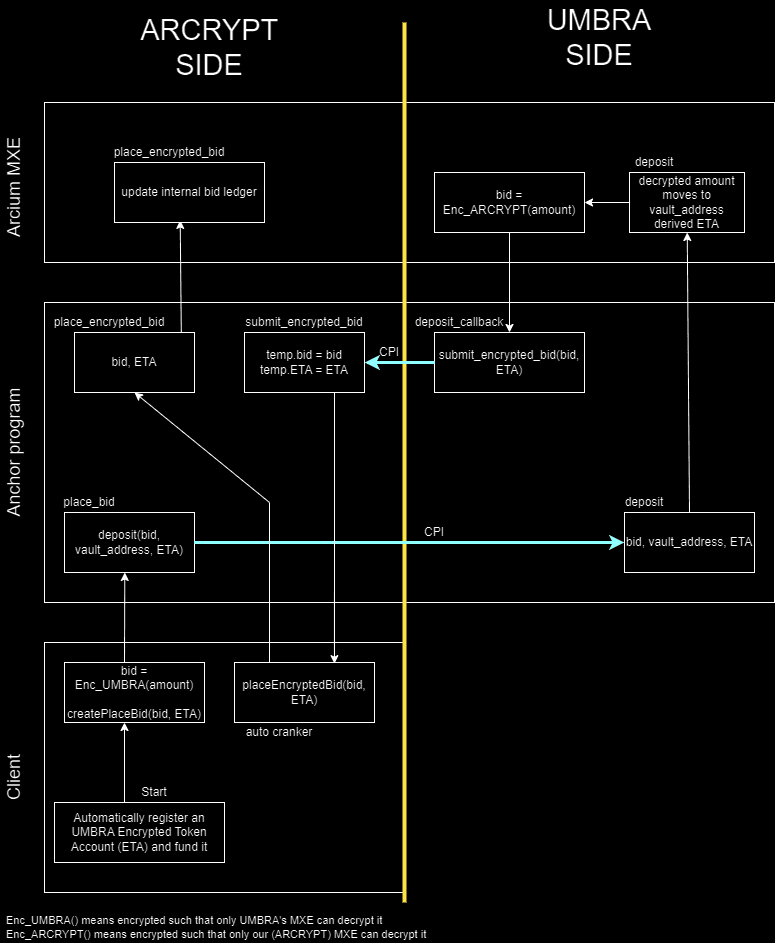
ARCRYPT automatically generates an UMBRA encrypted token account (ETA) associated with your wallet address. This ETA is the link between the private world and the public chain. Funds can be moved in and out of your ARCRYPT account in the Encrypted Balance page.
This enables you to move SPL tokens in and out of a private balance arbitrarily, thus obscuring your activity. All bids are made with USDC. Placing a bid will transfer funds from your ETA to an escrow account (transferring any missing funds from your public wallet, then to the ETA, then to the escrow) which is controlled by the ARCRYPT program. The escrow funds exist within the shielded pool.
The UMBRA program performs a rescue cipher of the bid amount against the ARCRYPT mixed execution environment, controlled by the Arcium MPC network. ARCRYPT validates the ciphertext and sends it to the MXE where we compare it against the current highest bid(s). The exact computation depends on the type of auction (see below).
Your bid or bidder identity is never revealed during this process, as the bid comparison computation is performed across hundreds of nodes in the Arcium network, such that no individual node can ever determine any information about the computation or its result.
We will eventually migrate to the confidential token standard to simplify the flow and directly read escrow accounts within the MXE, rather than sending the encrypted amount as ciphertext to the MXE.
Escrow deposit mechanism flowchart:
How to use Arcrypt
Seller flow
- Connect your wallet and select the on-chain asset you want to auction (an NFT or other single item).
- If applicable, you can connect with Realms, MetaDAO or any DAO that accepts arbitrary instructions to propose the auction of a specific treasury asset.
- Set a floor price and choose an auction type (first-price or Vickrey).
- Specify a custom duration (up to 30 days) and attach optional metadata (descriptions, provenance, external links).
- Publish the auction - bids remain encrypted until the reveal step, preserving bidder privacy throughout the process.
Auction types
- First-price auction: the highest bidder wins and pays exactly what they submitted.
- Vickrey (second-price) auction: the highest bidder wins but pays the second-highest bid, meaning incentive is bid your true value: nothing less and nothing more.
Settlement
- At auction close, bids are revealed and the winner is determined according to the chosen auction type.
- On-chain settlement transfers the asset to the winner and the winning bid to the seller; all escrowed bidders who didn’t win can claim refunds.
Create a DAO proposal
Connect directly with Realms, MetaDAO or any DAO that accepts arbitrary instructions to call the ARCRYPT program and propose to auction a treasury asset. Just specify the asset, duration, and auction rules as normal.
Developers
Install the SDK with:
npm install @arcrypt/sdkNote: the package is not deployed yet - use the SDK directly from the repository for now.
Core Functions
type CreateAuctionParams = {
  programClient: any;
  programId: PublicKey;
  publicKey: PublicKey;

  authorityBase58: string;
  sourceTokenAccountBase58?: string;

  minBidUsdc: string;           // e.g. "1.5"
  durationSecs: number;        // auction length in seconds

  auctionType: "FirstPrice" | "Vickrey";
  assetKind: "Nft" | "MetadataOnly";

  metadataUri: string;
};
Creates an auction instruction and returns a transaction bundle ready to send.
type CreatePlaceBidParams = {
  programClient: any;
  programId: PublicKey;
  publicKey: PublicKey;

  auctionPk: PublicKey;

  bidAmountSol: string;     // your bid for the item

  nonceHex?: string;
};
Encrypts and submits a bid using Arcium MPC.
type CreateDetermineWinnerParams = {
  programClient: any;
  programId: PublicKey;
  publicKey: PublicKey;

  auctionPk: PublicKey;
  which: "first" | "vickrey";
};
Triggers encrypted winner computation via Arcium.
type CreateSettlementParams = {
  programClient: any;
  programId: PublicKey;
  publicKey: PublicKey;

  auctionPk: PublicKey;
  auctionData: any;

  escrowExists?: boolean;
  action?: "auto" | "reclaimUnsold" | "claimRefund" | "settleWinner";
};
Automatically determines whether to reclaim, refund, or settle the auction.
For advanced usage, ARCRYPT also exposes lower-level transaction builders used internally by createSettlement. These allow you to explicitly control settlement behavior.
buildReclaimUnsoldTransaction()
buildClaimRefundTransaction()
buildSettleWinnerTransaction()
These functions return transaction bundles and require the same core inputs (programClient, programId, publicKey, auctionPk, auctionData).
Minimal Example
import { PublicKey } from "@solana/web3.js";
import { createAuction, createPlaceBid } from "@arcrypt/sdk";

async function main() {
  const programClient = /* your Anchor client */;
  const programId = new PublicKey("PROGRAM_ID");
  const wallet = new PublicKey("WALLET_PUBKEY");

  // 1. Create auction
  const auction = await createAuction({
    programClient,
    programId,
    publicKey: wallet,

    authorityBase58: wallet.toBase58(),
    minBidUsdc: "1.0",
    durationSecs: 3600,

    auctionType: "FirstPrice",
    assetKind: "Nft",

    metadataUri: "https://example.com/meta.json",
  });

  // 2. Place bid
  const bid = await createPlaceBid({
    programClient,
    programId,
    publicKey: wallet,

    auctionPk: auction.auctionPda,

    bidAmountSol: "10",     // your bid for the item
  });

  console.log("Auction TX:", auction.transaction);
  console.log("Bid TX:", bid.transaction);
}

main().catch(console.error);